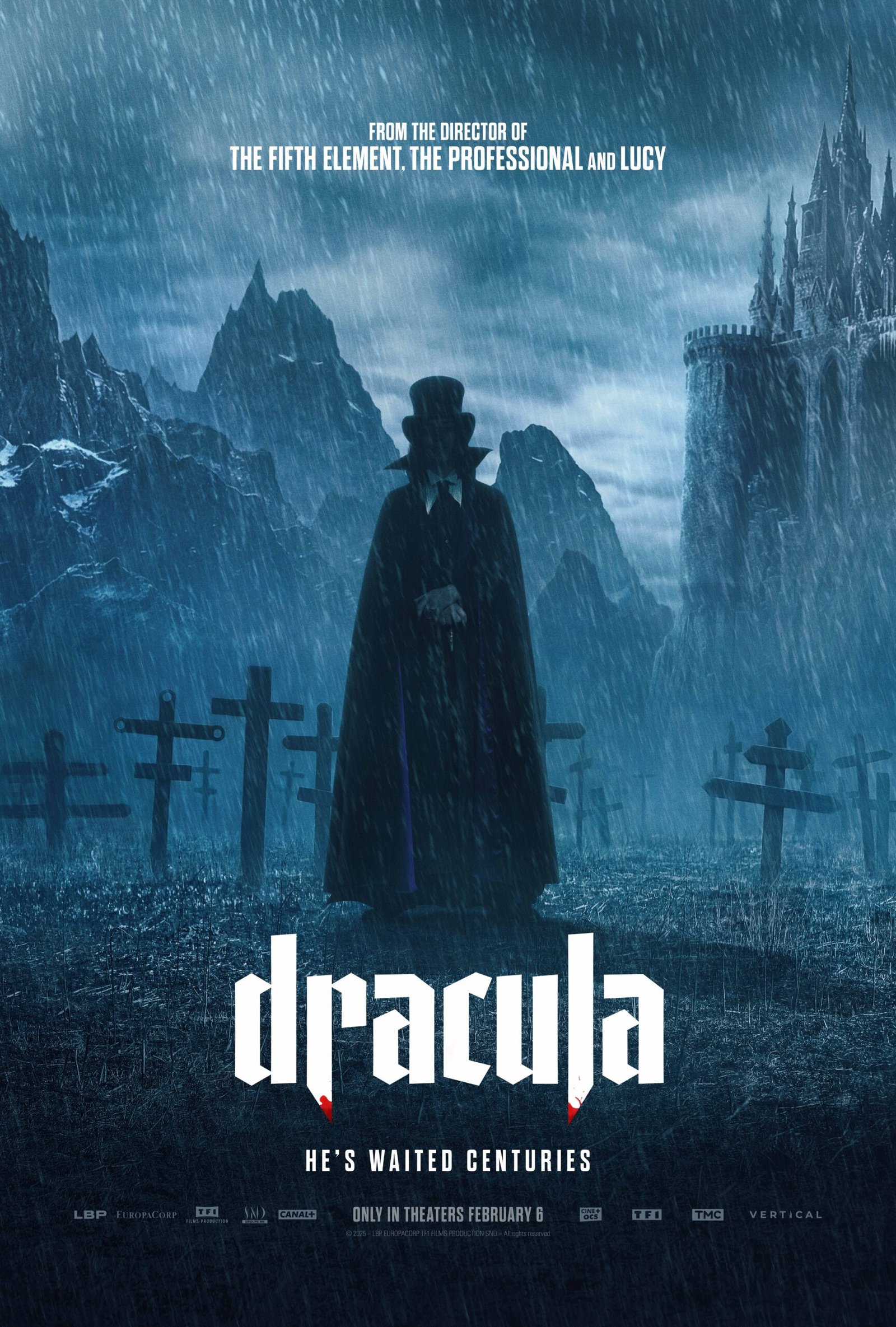
Over 100 films and TV productions are either based on Bram Stoker’s classic horror novel Dracula or feature characters from the story. A dozen are direct adaptations of the 1897 novel that introduces Count Dracula and his nemesis, Abraham Van Helsing, along with the hapless Jonathan Harker, Mina, Jonathan’s fiancée, Lucy, who is stricken by the Count, and Dr. John Seward, the primary narrator and the voice of reason. With that many adaptations, why are we still seeing new films focused on the Count? Because it’s a splendid tale that allows for much latitude with interpretation. Its malleability most recently caught the attention of director Luc Besson, a luminary of modern French cinema.
Besson offers a different take on the Count’s story, portraying him as a passionate romantic. Cursed with immortality, he is living out the centuries, questing for the woman who is the reincarnation of his beloved wife, Elizabeth. It’s still a gory horror film about the theft of individual agency, but this approach offers a more sympathetic Dracula who’s a heartbroken man on a quest.
The film opens in 1480 Romania, where the Prince (Caleb Landry Jones) and his wife Elizabeth (Zoë Bleu) are torn from a passionate embrace; He must lead his troops against Muslim invaders. The Cardinal (Haymon Maria Buttinger) assures him that his wife will be safe while he’s at the battlefield, insisting that their efforts are “the last bastion against the Muslims”.

The Romanians indeed rout the Muslims, but the Prince is horrified to learn that his wife has departed the castle during the battle. He follows her route, just to have her die in his arms. Disgusted, he swears at the Cardinal and renounces God, then seals his renunciation by performing a heinous act. A statue of Jesus weeps tears of blood upon hearing this utterance, and the Prince becomes the immortal Count Dracula.
400 years later, a priest (Christoph Waltz) has been invited to Paris by Dr. Dumont (Guillaume de Tonquédec) to help cure the mad Maria (Matilda de Angelis), a beautiful young woman who is a vampire under the Count’s spell. Her task, we learn, is to search the courts of Europe to find the reincarnated Elizabeth. Before being committed to the asylum, Maria had met the lovely Nina (Zoë Bleu) and befriended her; is Nina the one?
Meanwhile, Jonathan Harker (Ewens Abid) has accepted an invitation to visit the Count’s creepy Transylvanian castle to negotiate a real estate deal for a property that the Count owns in London. The Count is old, decrepit, and creepy as heck, inhabiting a castle defended by living gargoyles. Harker asks the Count to share his story and we learn about what’s happened in the 400 years since the opening scenes. Is Nina the reincarnated Elizabeth? Will Dr. Dumont and the priest rescue her before the Count gets his teeth into her beautiful neck? For that matter, will Jonathan escape the castle and help rescue his beloved Nina?
Stoker’s novel begins with Harker visiting Dracula’s castle; the 1480s Romanian battle sequence offers a sympathetic origin story for the Count. This presents Dracula as a lost soul yearning for a lost love rather than the embodiment of evil, and it’s one of many interesting twists Besson offers in this unusual and engaging variation on the story. The film is also all over the place tonally, offering up some wry moments, a cynical view of European nobility, and even a musical number, woven into a very gothic horror love story.
I really enjoyed this latest production of Dracula. The performances are very good, particularly Zoë Bleu, who brings an appealing fragility to Nina, then replaced by the wild abandon of Elizabeth. Even more so, the sets and exteriors are splendid, offering new visual ideas for well-trod ground, including Dracula’s Transylvanian castle. The cinematography was appropriately saturated, reminiscent of the equally beautiful gothic horror Crimson Peak(2015), Guillermo del Toro’s own gothic romance.
Romantic, but violent and horrific in scenes. Recommended.
This film review originally appeared on PlanetDave.comwith the title Film Review: Luc Besson’s Romantic, Uneven “Dracula”, and is republished with permission of the author, a Fan Dad!